Anteroom

Anteroom (a type of Secondary Engineering Control or SEC)

A room with fixed walls and doors that serves to protect the buffer room from contamination. Its primary purpose is a place where personnel hand hygiene and garbing occur. Material handling and transfer across the line of demarcation may occur there if a direct pass-through from the non-classified area to the buffer room is not present. The anteroom and buffer room together are called the cleanroom suite. An anteroom serving only a positive-pressure buffer room must meet ISO Class 8 conditions under dynamic operating conditions whereas anterooms serving a negative-pressure buffer room must meet at least ISO Class 7 conditions. An anteroom may benefit from higher than the minimum number of air changes per hour (ISO 7 at least 30 ACPH and ISO 8 at least 20 ACPH) based on the number of people using the room, areas it serves, physical design and activities occurring inside.
Before entering the anteroom or SCA, visit the restroom…
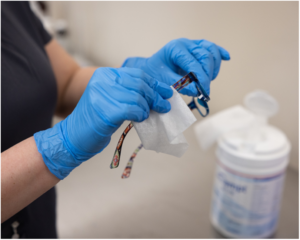
Before entering the anteroom or SCA, visit the restroom, tie up hair and clean personal glasses. Use an EPA-registered germicidal cleaner (PreEmpt Plus or TB-1) on the frames but use individually-wrapped lens cleaner wipes on lenses since IPA and cleaning agents may damage lenses.
Store garb where it will be donned and in a manner that…
Store garb where it will be donned and in a manner that protects it for contamination. Facemasks, bouffant caps, hoods, beard covers and shoe covers are best stored in this location.  Face masks must be donned with the folds facing down on the outside of the mask, creating little ‘pockets’ to catch exhalations of breath on the inside of the mask. Cleanroom grade masks are recommended since they have a coating on the outside that reduces the potential for moisture bleed-through. Either a loop or tie mask is fine if it fits snugly and without any gaps. For correct fit, bend the metal bar so that it molds to the bridge of the nose. While holding the top of the mask, pull the bottom of the mask down underneath the chin.
At the line of demarcation (LOD), a bench or stool should…
At the line of demarcation (LOD), a bench or stool should be placed to permit staff to sit down while donning shoe covers. Shoe covers are donned one foot at a time, moving the covered foot from the “dirty side” to the “clean side.”
Life safety signs are required by local law showing how to…
Life safety signs are required by local law showing how to exit the cleanroom suite in an emergency. These and other irregularly shaped features require the use of a cleanable step stool to clean these manually on at least a monthly basis.
If the opportunity to build or renovate older rooms…
If the opportunity to build or renovate older rooms presents itself, think carefully about the placement of windows to ensure visualization of critical activities within each space.
Instead of built in shelving or storage, consider the use…
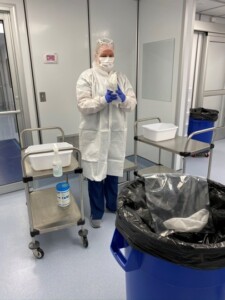
Instead of built in shelving or storage, consider the use of stainless steel tables, carts, or shelving on wheels to provide flexibility and increase ease of cleaning and disinfecting.
Large cleanable trash bins on dollies with wheels lined…
Large cleanable trash bins on dollies with wheels lined with plastic bags make trash management easier.
Air supplied to the cleanroom suite must be introduced…
Air supplied to the cleanroom suite must be introduced through HEPA filters located in the ceiling of the rooms. The surfaces of the ceiling must be smooth, impervious, free from crack and crevices and cleanable. Ceilings of inlaid panels (a design that is most flexible) must be caulked between the panels and the support frame. Installed lighting must be sufficient to provide working lighting and the external lens of the ceiling light fixtures must be smooth, flush-mounted and sealed. Sprinklers are required by local law in case of fire and flush mounted, cleanable sprinklers are strongly recommended.
Air returns must be low on the wall in the cleanroom suite…
Air returns must be low on the wall in the cleanroom suite (ante and buffer rooms) resulting in general top to bottom airflow. In the absence of low wall returns, there must be a visual smoke study that demonstrates an absence of stagnant airflow.
Reusable cleaning tools such as mops must be dedicated for…
Reusable cleaning tools such as mops must be dedicated for use in the classified areas or the SCA. Here you see a Toolflex One™ that can be mounted using adhesive strips (try to avoid drilling holes in cleanroom wall panels in case items need to be relocated later) to hang dedicated mop such as the MicroCinch™ mop system for floors and the KleanMax™ mop system for walls and ceilings. Though not required by USP <797>, mop heads should be disposable. Never allow cleaning tools used at other locations to be used in sterile compounding areas.
Store gowns (both HD and non-HD) in closed storage at least…
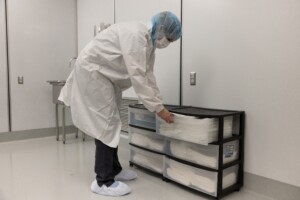
Store gowns (both HD and non-HD) in closed storage at least 1 meter away (more if possible) from the sink. Use plastic drawers on wheels with see through drawers to make it easier to see when restocking is needed.
USP <797> permits the reuse of a gown by the same…
USP <797> permits the reuse of a gown by the same person for one shift provided the gown is stored in a classified area after doffing. However, Contec recommends that you consider not reusing gowns. Remember the arms of the gown are placed directly inside the PEC so any contamination the gown has picked up is brought directly into the DCA. If your facility permits gown reuse, they are best hung on the clean side of the anteroom and at least 3 feet away from the sink. Gloves are discarded. It is also recommended that the person crosses the line of demarcation to remove their head, face and shoe cover on the dirty side and dispose of them there.
Since persons performing hand hygiene are required by USP…
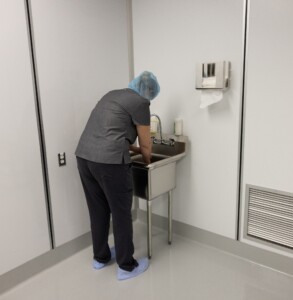
Since persons performing hand hygiene are required by USP <797> to lather hands, wrists, and forearms for 30 seconds, it is helpful to hang a large easily readable clock with a second hand on the wall above the sink so workers can time lathering. The clock should be removed at least monthly and the surface behind the clock and the clock itself cleaned and disinfected with an EPA-registered, one-step sporicidal agent like PeridoxRTU.
It is helpful to cover the exposed pipes below the sink…
It is helpful to cover the exposed pipes below the sink with a shroud as shown here. It makes ongoing cleaning and disinfection activities easier. If the pipes and plumbing are exposed, it must be cleaned and disinfected at least monthly, which can be very tedious and time consuming. Just ensure that you provide a way to access the plumbing for future repairs.
Sinks should enable hands-free use which can be an…
Sinks should enable hands-free use which can be an electronic eye as seen here but also can be as simple as faucet extenders so the water can be operated with workers’ elbows. Preset the water temperature to warm to facilitate less manipulation of the faucets as is done with electric eye faucets. Foot controls for the water are not recommended since they are difficult to clean and disinfect and knee controls can be difficult or painful for those who have artificial knees or arthritis.
Automatic soap dispensers for hand hygiene may be used but…
Automatic soap dispensers for hand hygiene may be used but workers are cautioned to use them in a manner that does not leave excess soap dispensed in puddles on the floor or wall. The dispenser also needs to be cleaned at regular intervals to remove excess soap buildup which may be a locus for contamination. A shelf may also house pump dispensers of soap, but SOPs must include daily cleaning of soap container which much never be refilled and must be discarded when it is empty.
USP <797> requires use of low lint wipes in the…
USP <797> requires use of low lint wipes in the controlled areas. To reduce cost, Contec has low lint hand drying wipes which fit in a stainless dispenser that can be adhered to the wall near the sink. Secure packaging protects wipes from exposure and cross-contamination. Interleaved, single-wipe dispensing prevents waste and keeps remaining wipes clean, even with wet hands.
USP <797> requires that junctions between the walls…
USP <797> requires that junctions between the walls and the floors must be sealed to eliminate crevices where dirt and contamination can build up and a coved floor to wall is the best way to do that. Always ensure the junction of the cove to the wall is sealed. Depending on its size, it may need to be cleaned manually. The coved part of the floor is cleaned with daily cleaning.
Hands-free doors to enter buffer rooms are recommended. It…
Hands-free doors to enter buffer rooms are recommended. It is important to understand however that the door to the anteroom and the door to the buffer room cannot be open at the same time, so coordination of those movements is important. EVS and staff must understand how to operate the doors, which must be switched to manual operation and opening for daily cleaning of all surfaces of the doors and tracks. Ensure the “eye” for door opening is in a place where routine operator movement will not trigger it.
Materials may be transferred into the buffer room in the…
Materials may be transferred into the buffer room in the anteroom because your facility does not have a pass-through. While wearing gloves, take each items one at a time off the dirty cart and wipe all surfaces. When finished reach across the LOD and place it on a clean cart. If there are many items to be transferred in, Contec strongly recommends donning masks, and head covers since long periods when ungarbed personnel are on the dirty side can compromise the environment.
Though USP <797> does not require a mirror…
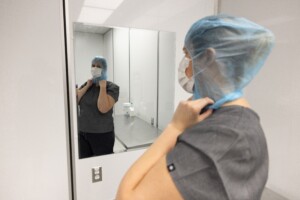
Though USP <797> does not require a mirror, placement  of a mirror is the only way to check that garb is donned properly and that hair is fully contained in head cover. Ensure that caulk is placed around the edges of the mirror so that no water gets behind it and becomes a vector for contamination. Take the time to garb properly. Once garb is donned it should not require adjustment. Touching garb must be avoided.
Don gowns well away from the sink. If entering a…
Don gowns well away from the sink. If entering a nonhazardous buffer room, after donning the gown, pull the sleeves up a bit to leave the wrists exposed and do not put the thumb loop in place until later. If entering a hazardous buffer room, don the back-closing hazardous gown over the nonhazardous gown before entering the buffer room.

You see a 360° image of the Anteroom which you can rotate by using your mouse (or finger when on mobile). You can click on the hotspots to find out more about the best practices.

Display hotspots
On
Off