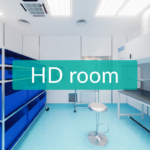
Hazardous Buffer Room
Hazardous Buffer Room (Containment Secondary Engineering Control or C-SEC)
The HD buffer room must maintain the same conditions and meet the same requirements as the nonhazardous buffer room except that this room must maintain negative pressure of between 0.01 to 0.03 inches water column to any adjacent area such as the ISO 7 anteroom. The other difference is that both the room and the containment primary engineering controls (C-PECs) placed inside must be externally vented.
Though not required by USP <797> or <800> some…
Though not required by USP <797> or <800> some pharmacy regulators require pass-throughs into ISO 7 negative spaces to be ISO classified so when the door to the pass-through is opened, it does not pull “dirty” room air into the buffer room. This is controversial. Pass-throughs are not large spaces. They open directly into the SEC with HEPA filters and returns. These large spaces clean the small amount of dirty air let into the buffer room. It is strongly recommended that air sampling is performed at the location of the pass-through in the HD buffer room (opening and closing the pass-through door during sampling) to collect data about the state of the air which can be shown to inspectors. Ensure both doors to the pass-throughs are not opened at the same time but interlocking pass-through doors are strongly recommended. Another best practice is to refrain from locating pass-throughs within 6 feet of C-PECs.
A dedicated refrigerator (solid state with an internal…
A dedicated refrigerator (solid state with an internal compressor is preferred) is required to store HDs that must be stored at controlled room temperature. Place the refrigerator several inches away from the wall but in front of a low wall air return. One best practice is to “receive” HDs inside the C-SEC. Decontaminate the outside of HD outer packaging and store HDs in their packaging to help prevent spills if the container is jarred during storage. When used, discard outer packages in trace waste. Decontaminate the primary container by wiping with decontamination agent (PeridoxRTU) and place on the staging table. The drug container must be wiped with sIPA before transferring into C-PEC for use.
A containment primary engineering control (C-PEC), in this…
A containment primary engineering control (C-PEC), in this case a biological safety cabinet (BSC) is required for sterile compounding of hazardous drugs. If it is properly integrated into the facility and is installed and maintained correctly, the BSC will maintain ISO 5 conditions generating unidirectional first air while simultaneously maintaining negative pressure therefore containment of HD particulates. Operators can also use RABS type compounding aseptic containment isolator (CACI) though they are much more difficult to work inside and to clean, clearly offering no advantage over BSCs.
USP <797> requires a “line of demarcation” for…
USP <797> requires a “line of demarcation” for donning and doffing PPE. Donning PPE occurs in the usual locations, but doffing does not, and workers must be careful to follow the sequence if HD residues are to be contained. Best practice is to permanently mark a doffing area. A trace waste container and stool should be positioned in the buffer room right outside the doffing line.
Ensure that no worker or visitor enters compounding areas…
Ensure that no worker or visitor enters compounding areas (anteroom, cleanroom suites, SCA or C-SCA) without being properly garbed. Consider a written policy governing who may enter these areas, what kind of garb they must wear, who may clear visitors, and how they are escorted and supervised. Minimize trips in and out of the anteroom and buffer room through organization and material handling that ensures the right number and type of components for each prep/batch. The goal is for each compounder to take their time garbing properly and enter the compounding area with 2 to 3 hours of work to do before needing to leave.
Waste receptacles must be dedicated to the HD buffer room…
Waste receptacles must be dedicated to the HD buffer room and lined with yellow (or as local, state, or federal law requires) trace waste bags. Remember when removing bags, do so away from any C-PEC to ensure particles are not pushed into the DCA.
Keep sterile 70% IPA and the decontamination agent used…
Keep sterile 70% IPA and the decontamination agent used inside the C-PEC. Remember these need to be in a non-spray format. USP <797> requires that both the applicators and the agents to be sterile. Sterile PeridoxRTU and sterile wipes such as EasyReach Pads and SterileSorb™ can be used for daily decontamination before cleaning and disinfection as well as between different HD drugs for different patients. SterileSorb wipes are intended for irregular surfaces such as the IV bar and hangers, while the EasyReach tool should be used on larger flat surfaces, and at no time should you lean your body into the C-PEC. It may be useful to use sterile bags to make a smaller number of SterileSorb wipes presaturated with PeridoxRTU. This can be done once a day or once per shift so that an entire packet of wipes and Peridox container can be sealed and kept outside of the C-PEC to preserve space. If sterile items are opened and resealed only in ISO 5 air and labeled for ISO 5 use only, they may be kept outside the C-PEC provided they are wiped with sIPA before transferring back into the C-PEC.
A stainless worktable is useful for donning sterile gloves…
A stainless worktable is useful for donning sterile gloves. A container like this with transparent front is an efficient way to store sterile, powder free, HD gloves. Keep sterile 70% presaturated alcohol wipes along with alcohol-based hand rub to use during this process.
Remove a package of sterile gloves from storage. Check the integrity of its packaging as well as the expiration date. Discard the gloves if the package is damaged or expired. Carefully remove the outer package from the gloves and place the unopened sterile glove package on the gloving table. Apply an alcohol-based hand rub to all surfaces of the hands and wrists. Pull the sleeves down and put the thumb loop in place. Don sterile gloves. Discard the packaging. Sanitize gloves with sIPA wipes.
Remove a package of sterile gloves from storage. Check the integrity of its packaging as well as the expiration date. Discard the gloves if the package is damaged or expired. Carefully remove the outer package from the gloves and place the unopened sterile glove package on the gloving table. Apply an alcohol-based hand rub to all surfaces of the hands and wrists. Pull the sleeves down and put the thumb loop in place. Don sterile gloves. Discard the packaging. Sanitize gloves with sIPA wipes.
This is a good place to keep the HD Spill Kit, as well as…
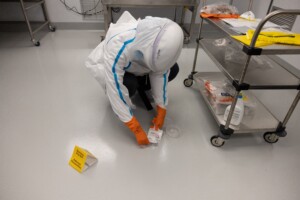
This is a good place to keep the HD Spill Kit, as well as an ancillary spill kit including a PAPR/CAPR.
The direct compounding area (DCA) is the critical area…
The direct compounding area (DCA) is the critical area within the ISO 5 PEC where critical sites are exposed to unidirectional first air, the location of which is identified in dynamic airflow smoke pattern testing. Unidirectional first air will be different in a C-PEC than in a PEC. The air will be generated from the top down so it will flow vertically. It also will split close to the deck and be pulled in front and back. Manipulation of syringes, vials and critical sites is much different inside of a device with vertical air. Conduct new smoke pattern testing if the size or location of the DCA changes due to increased numbers of cleaning items being stored in the PEC or introduction or new equipment such as an automated compounder are introduced to the PEC.
One best practice is order of doffing is as follows:
1…
One best practice is order of doffing is as follows:
1. Doff outer sterile gloves in C-PEC
2. Doff HD gown standing outside the doffing area. Grasp chest and carefully pull gown forward and roll it up inside out. Discard in trace trash.
3. Sit on bench and carefully remove outer shoe cover of shoe nearest doffing line. Be careful not to contaminate inner shoe cover.
4. Place foot on inside of the doffing area.
5. Repeat with other foot and step into doffing area.
6. Remove gloves by grasping first glove body at the upper palm. With other gloved hand, peel it off slowly. Keep that glove in palm of the other gloved hand, use index finger of ungloved hand to slowly peel off 2nd glove making an inside out pouch. Discard in trace waste.
7. Leave buffer room.
8. Discard nonhazardous gown worn under the HD gown (or hang it up if your organization permits gown reuse).
9. Wash hands with soap and water.
10. Cross LOD and remove shoe covers, head, and face covers (none of which are contaminated with HD residue if donned properly).
1. Doff outer sterile gloves in C-PEC
2. Doff HD gown standing outside the doffing area. Grasp chest and carefully pull gown forward and roll it up inside out. Discard in trace trash.
3. Sit on bench and carefully remove outer shoe cover of shoe nearest doffing line. Be careful not to contaminate inner shoe cover.
4. Place foot on inside of the doffing area.
5. Repeat with other foot and step into doffing area.
6. Remove gloves by grasping first glove body at the upper palm. With other gloved hand, peel it off slowly. Keep that glove in palm of the other gloved hand, use index finger of ungloved hand to slowly peel off 2nd glove making an inside out pouch. Discard in trace waste.
7. Leave buffer room.
8. Discard nonhazardous gown worn under the HD gown (or hang it up if your organization permits gown reuse).
9. Wash hands with soap and water.
10. Cross LOD and remove shoe covers, head, and face covers (none of which are contaminated with HD residue if donned properly).
Do not talk while compounding. This will reduce the…
Do not talk while compounding. This will reduce the potential for error and decrease particulate generation to the DCA from outgassing of the mask. In general, the compounding area is not the place for work chit chat. Talking increases the wetness of your mask which reduces its efficiency. Since you are performing mission critical activities, idle conversation is discouraged so you can focus on the work. Consider prohibiting music in the buffer room to increase worker concentration. Music is often turned up to a high volume to overcome the sound of the HVAC, so that workers need to raise their voices to be heard. Raised voices increase particle generation. Background noise at these levels can also cause long-term hearing loss.
You see a 360° image of the Hazardous Buffer Room which you can rotate by using your mouse (or finger when on mobile). You can click on the hotspots to find out more about the best practices.
Display hotspots
On
Off