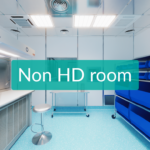
Non Hazardous Buffer Room
Non Hazardous Buffer Room (a type of Secondary Engineering Control or SEC)
An ISO Class 7 or cleaner room with fixed walls and doors where primary engineering controls (PECs) that maintain ISO Class 5 conditions are located. Non-hazardous buffer rooms maintain 0.020-inch water column positive pressure to the anteroom and are required to achieve ≥ 30 air changes per hour. Surfaces must be smooth, impervious, free from cracks and crevices and nonshedding.
Pass-throughs improve efficiency and reduce the number of…
Pass-throughs improve efficiency and reduce the number of trips into and out of the anteroom also reducing the potential for microbial contamination. Optimally a pass-through should be placed between the general pharmacy “prep area” (area immediately outside of the anteroom entrance) and the nonhazardous buffer room and used to transfer items as well as staged preps/batches into the buffer room. Though not required by USP <797>, pass-throughs should have interlocking doors but if they do not then both doors may not be open at the same time. USP <797> does require that the doors of pass-throughs be sealed.
Life safety signs are required by local law. These and…
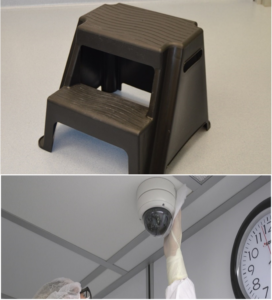
Life safety signs are required by local law. These and other types of irregular surfaces such as cameras, tops of doors, clocks, etc. must be cleaned manually therefore an easily cleanable stool is recommended. A step stool must be dedicated to the HD buffer room with another shared between the non-hazardous buffer room and anteroom.
A stainless worktable is useful for donning sterile gloves…
A stainless worktable is useful for donning sterile gloves. A container like this with transparent front is an efficient way to store sterile gloves. Keep spray 70% sterile IPA or sterile 70% presaturated alcohol wipes along with alcohol-based hand rub to use during this process. Remove a package of sterile gloves from storage. Check the integrity of its packaging as well as the expiration date. Discard the gloves if the package is damaged or expired. Carefully remove the outer package from the gloves and place the unopened sterile glove package on the gloving table. Apply an alcohol-based hand rub to all surfaces of the hands and wrists. Pull the sleeves down and put the thumb loop in place. Don sterile gloves. Discard the packaging. Sanitize gloves with sIPA.
Stainless steel supply carts can accommodate “fast moving”…
Stainless steel supply carts can accommodate “fast moving” items such as those that would be used if your operation compounds parenteral nutrition and needs frequent change of source containers. The buffer room should not become a storage place. Keep only enough stock to service 2 to 3 days, a week at most.
It is important that those who are compounding maintain…
It is important that those who are compounding maintain good body alignment and comfort. Stainless steel pedestal type, adjustable height stools with a footrest are recommended as they are comfortable but easy to clean. Stools typically have 6 wheels, each of which is difficult to clean and increases time spent during monthly cleaning. Remember anti-fatigue mats are not recommended. They are difficult to clean properly and harbor contamination.
Treat the staging table in the same way as the deck of the…
Treat the staging table in the same way as the deck of the PEC. Wipe the top of the staging table between preps/batches. The top shelf should contain only the paper documentation (if any) and components for the current batch/prep as well as either sterile 70% presaturated wipes or low-lint wipes and sterile spray 70% IPA. Failure to routinely clean, disinfect and sanitize the staging table used by each compounder to stage components coming in and out of the PEC is a common cause of surface sampling excursions inside the PEC.
Wear gloves and wipe (do not spray) all surfaces of any…
Wear gloves and wipe (do not spray) all surfaces of any supply or component destined for the buffer room. Though the use of sIPA and germicidal detergents is permitted, the use of an EPA-registered one-step sporicidal disinfectant cleaner, such as PeridoxRTU is strongly recommended. Evidence in the literature has demonstrated that items are contaminated with spores and only the sporicidal agent can successfully prevent their introduction to the compounding area. This wiping process can occur in the prep area directly outside the cleanroom suite, placing items into the pass-through or inside the anteroom passing items from dirty to the clean side. Remember all sporicidal agents give off noxious odors so use vapor-limiting and containing strategies to reduce their impact.
USP <797> requires the use of sterile cleaning agents…
USP <797> requires the use of sterile cleaning agents and applicators inside the PEC. Use the sterile packaging from applicator heads (such as the Easy Reach mop head) to replace the zip lock bag approach to saturating applicators or purchase sterile bags for this purpose. Contec recommends keeping sterile IPA presaturated wipes and critical site wipes inside the PEC to the left of the DCA. These items are used frequently throughout the day and must stay in ISO 5 air. Be sure to “burp” the air from the package and close them completely after each use.
The direct compounding area (DCA) is the critical area…
The direct compounding area (DCA) is the critical area within the ISO 5 PEC where critical sites are exposed to unidirectional first air, the location of which is identified in dynamic airflow smoke pattern testing. Conduct new smoke pattern testing if the size or location of the DCA changes due to increased numbers of cleaning items being stored in the PEC or introduction or new equipment such as an automated compounder are introduced to the PEC.
The interior of PECs must be cleaned and disinfected and…
The interior of PECs must be cleaned and disinfected and wiped with sIPA at least daily by compounding personnel. One acceptable sequence for cleaning inside an LAFW is:
1. Irregular surfaces (IV pole, hangers, bolts, etc.)
2. Ceiling
3. Back
4. Sides
5. Items on the deck
6. The deck itself
1. Irregular surfaces (IV pole, hangers, bolts, etc.)
2. Ceiling
3. Back
4. Sides
5. Items on the deck
6. The deck itself
When LAFWs are placed in ISO 7 rooms, check the prefilters…
When LAFWs are placed in ISO 7 rooms, check the prefilters every 3 months to ensure they are not dirty. These can be changed by the certifier every 6 months. In SCAs however, the room air is not controlled, so prefilters should be checked and changed, if required, monthly. Always document this process.
All surfaces of floors must be cleaned daily from the…
All surfaces of floors must be cleaned daily from the furthest part of the room working to the door to the anteroom. The same mophead may be used in for the anteroom floor if the cleaning is performed in that order. Use a daily germicidal detergent such as PREempt® Plus applying the agent in slightly overlapping strokes, in an S-curve pattern, ensuring complete coverage. Hydrogen peroxide cleaners are powerful on dirt but low in toxicity. Ensure those performing cleaning thoroughly wet the applicator which must be changed when it becomes dirty or is not wet enough to achieve the manufacturer’s dwell time (1 minute for PREempt® Plus or TB1-3300™). Also be careful not to overapply cleaning agents which results in a faster buildup of residue and sticky feeling to the floor. Though not required by USP <797>, it is recommended that residue on the floor is removed weekly with sterile water for irrigation. If desired for aesthetic reasons, sterile IPA can be used to remove cleaning residues from windows.
USP <797> requires the ceiling (and walls) in…
USP <797> requires the ceiling (and walls) in cleanroom suites to be cleaned and disinfected at least monthly with a sporicidal agent like PeridoxRTU and a mop such as the KleanMax™. Limiting the number of wet surfaces at one time will reduce odors generated by sporicidal agents. To mitigate odors during monthly cleaning, wet only the ceiling, then one or two walls at a time depending on the size of your buffer and anterooms. While the ceiling is wet, clean a piece of furniture until the ceiling dries and the odor disperses. Continue in this manner until all surfaces of the room have been cleaned and disinfected.
USP <797> requires the walls (and ceiling) to be…
USP <797> requires the walls (and ceiling) to be cleaned and disinfected at least monthly with a sporicidal cleaning agent. Before cleaning the walls, clean all irregular surfaces (air returns, outlets, life safety signs, etc.) by hand with a wipe.
When cleaning the flat surfaces of walls using a mop like the KleanMax™ use slightly overlapping strokes to ensure complete coverage with the disinfectant cleaner. It is recommended to clean and disinfect only one or two walls at a time to reduce odor dispersal from PeridoxRTU. It is also important to place all discarded applicators in closed trash. If a bag or trash receptacle is left open, the odor will be dispersed by the air currents in the room.
When cleaning the flat surfaces of walls using a mop like the KleanMax™ use slightly overlapping strokes to ensure complete coverage with the disinfectant cleaner. It is recommended to clean and disinfect only one or two walls at a time to reduce odor dispersal from PeridoxRTU. It is also important to place all discarded applicators in closed trash. If a bag or trash receptacle is left open, the odor will be dispersed by the air currents in the room.
Previously pointed out in the anteroom, this is a low wall…
Previously pointed out in the anteroom, this is a low wall air return which will be spaced throughout the room. Also notice the coved flooring. This horizontal space is considered part of daily floor cleaning.
All work surfaces and pass-through chambers must be cleaned…
All work surfaces and pass-through chambers must be cleaned and disinfected daily. Other surfaces that should be cleaned and disinfected daily include frequently touched surfaces such as door rails, intercoms, stools, etc. It is also strongly recommended that work surfaces are wiped with sIPA regularly throughout the compounding day.
Ideally, perform daily cleaning at the end of the…
Ideally, perform daily cleaning at the end of the compounding day to allow the room to rest in a clean state. Remember when no activity occurs in the room, it remains clean. For 24-hour pharmacies, plan a time to clean each day. Know how long it takes to clean your PECs, buffer, and anteroom. Measure how long daily and monthly cleaning activities take so you can staff appropriately.
Allow sufficient time for cleaning and drying, since the room may not be used for compounding until it is dry. This requires planning with EVS and alternate compounding locations for stat orders which may occur during the cleaning time.
Allow sufficient time for cleaning and drying, since the room may not be used for compounding until it is dry. This requires planning with EVS and alternate compounding locations for stat orders which may occur during the cleaning time.
Whether sitting or standing during cleaning or compounding…
Whether sitting or standing during cleaning or compounding, ensure that the operator’s head does not break the front plane of the LAFW. Use of an Easy Reach™ Cleaning Tool will help the operator effectively reach surfaces in the PEC. Instead of taking the tool in and out of each PEC, it is best to keep the tool inside each PEC. Hang it from the IV bar far outside of the DCA.
In addition to the LAFW sequence, in a RABS type CAI…
In addition to the LAFW sequence, in a RABS type CAI additionally clean and disinfect:
– The interior view screen
– The entire length of the sleeves ensuring the surface at the junction of the sleeve and glove is wiped in its entirety.
– The deck
– Remove hands from ports.
– Change sterile gloves attached to the sleeves leaving them to rest in the sterile paper (in non-24-hour pharmacies) covering the gloves at the end of daily cleaning.
– The interior view screen
– The entire length of the sleeves ensuring the surface at the junction of the sleeve and glove is wiped in its entirety.
– The deck
– Remove hands from ports.
– Change sterile gloves attached to the sleeves leaving them to rest in the sterile paper (in non-24-hour pharmacies) covering the gloves at the end of daily cleaning.
After a batch/prep is completed, it exits the PEC to the…
After a batch/prep is completed, it exits the PEC to the staging table. Place it with any documentation and other items into a container that your organization uses for transport out of the compounding area. Place it in the pass-through or other area for finished CSPs. Wipe the top shelf of the now empty staging cart with sIPA and allow it to dry. Bring the components for the next batch/CSP to the top shelf of the staging cart to begin.
Be wary of storing containers of daily disinfectants in the…
Be wary of storing containers of daily disinfectants in the PEC. These items will cause an additional zone of turbulence and reduce the size of the DCA. If these items are opened and closed only in ISO 5 air and are cleaned and disinfected before reintroducing them to the PEC, it is acceptable to store them in the buffer room provided they are labeled “ISO 5 only”.
Remember that cleaning and disinfecting are every bit as…
Remember that cleaning and disinfecting are every bit as important as compounding! Contec recommends use of an EPA-registered one-step disinfectant cleaner ensuring achievement of the manufacturer’s contact time to streamline cleaning processes. These agents clean and disinfect in one step. If the agent is not an EPA-registered one-step disinfectant cleaner, then the surfaces must be cleaned and then disinfected which will require two separate wipe downs.
• Clean from top to bottom, left to right and back to front.
• Use unidirectional slightly overlapping strokes, never circular motions.
• Clean from top to bottom, left to right and back to front.
• Use unidirectional slightly overlapping strokes, never circular motions.
Achievement of contact time, also known as dwell time, is…
Achievement of contact time, also known as dwell time, is required by USP <797> to properly clean and disinfect non-porous surfaces inside the sterile compounding cleanroom suite and SCA. Dwell time is specified by each agent’s manufacturer and is the time the chemical must remain wet on the surface to have its intended effect. Ensure your staff knows the contact time of the disinfectant cleaners used at your facility.
You see a 360° image of the Non-hazardous Buffer Room which you can rotate by using your mouse (or finger when on mobile). You can click on the hotspots to find out more about the best practices.
Display hotspots
On
Off